
The approach
Physio-informed acupuncture
Three elements work together: a clinical assessment, Japanese acupuncture technique, and ultrasound guidance when appropriate.
Clinical assessment
Before any needle is used, your complaint is assessed the way it would be in orthopaedic or physiotherapy care — history, movement, and relevant physical findings. This shapes what's treated and how, rather than applying a fixed protocol.
Japanese acupuncture
Japanese acupuncture technique uses very fine needles and a gentler touch than some other styles. Treatment is typically whole-body, addressing the nervous system and general balance alongside the specific complaint.
Ultrasound guidance
For certain musculoskeletal complaints, ultrasound imaging is used during treatment to see the relevant structures in real time — allowing more precise, informed needle placement. It's used when it adds clinical value, not as standard for every complaint.
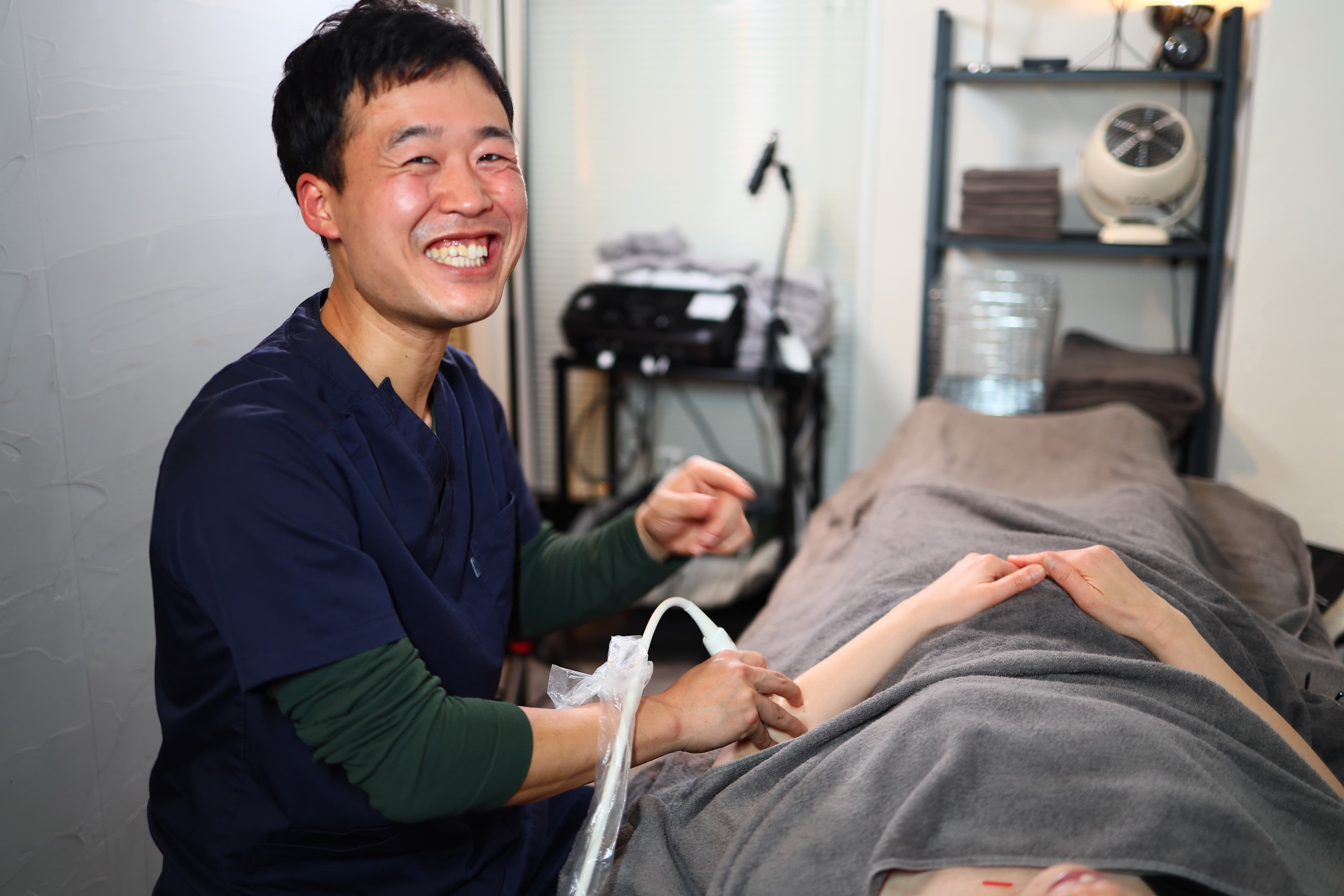
Ultrasound-guided assessment when appropriate
Precise needle placement depends on a clear picture of the relevant anatomy. When appropriate, ultrasound imaging — based on the principles of sonoanatomy — helps visualize the relevant structures and supports more precise, clinically reasoned treatment.
Ultrasound may help improve clarity, confidence, and reproducibility in treatment planning.
This combination is why treatment isn't limited to sports injuries or musculoskeletal pain. The same clinical, assessment-led approach applies to dizziness, tinnitus, headaches, sleep problems, eye strain, menopause-related symptoms, fatigue, and stress-related physical complaints.
Not every session needs ultrasound guidance — it's used selectively, when it genuinely adds precision. The ultrasound assessment is available as an add-on to the first session.